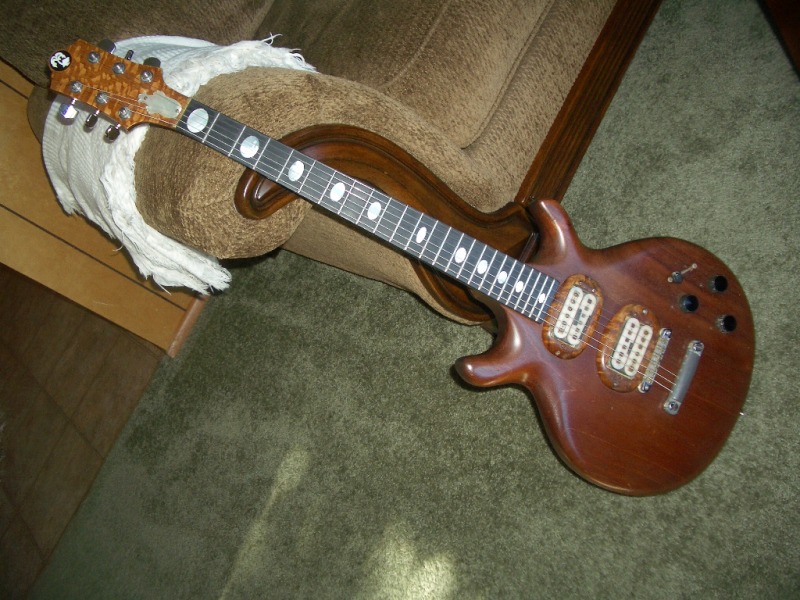
Here's a follow-up post to my previous write-up on Oasis guitars - the instrument I'm profiling here is apparently an early version of builder Gary Cooper's work and given the logo, would actually qualify as a prototype for his Oasis guitars.
This guitar was recently put up for sale in California by someone who found it via an estate sale or something to that effect. The lore that came with the guitar was that it was built circa 1975 by Gary Cooper, which would be a few years before the blonde mahogany one profiled in the earlier article.
My earlier article also had a picture of another Oasis "prototype" - the truth is that Cooper was probably building a small number of custom instruments, of the same overall form, but differing in the woods used, pickups and trim. Note that the bound-top prototype has the same Oasis palm tree and pyramid logo, but is missing the name "Oasis" on the headstock - the name was apparently an addition to production instruments.
This guitar has some features that are similar to the production models - such as oval pickup surrounds - though on this instrument they are carved from what I believe is walnut as opposed to being made of plastic.
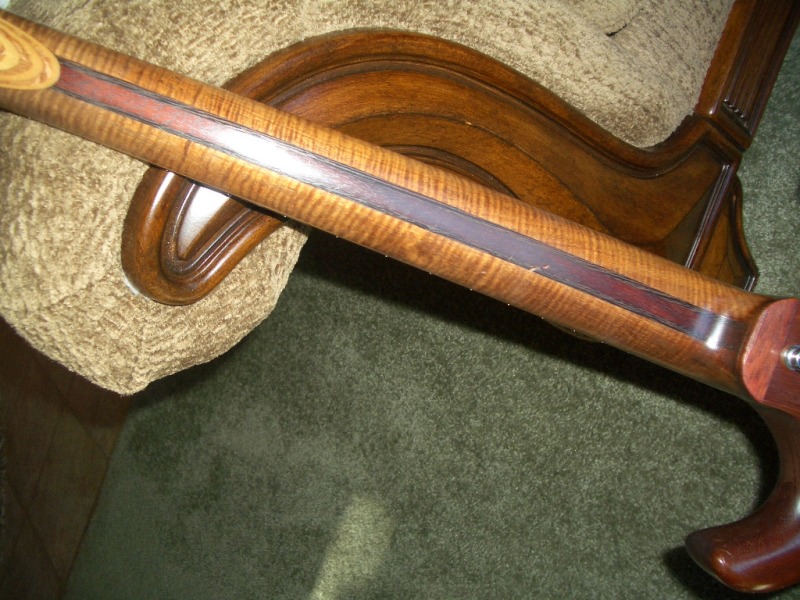
The oval fingerboard inlays also seem unique to this example - but the laminated neck construction is common to all three guitars I have pictures of - they just all use different combinations of wood.
One very different feature on the instrument is the headstock construction - which has a separate piece of oak (?) attached with a scarf joint. The Schaller tuners are consistent with the other Oasis guitars profiled.
One missing feature is the glued on Oasis label on the rear control cavity cover - perhaps because this is a prototype or perhaps because the rear cover was changed out at some point. The current cover appears to be a black cover similar to the cover on production Oasis guitars.
The bridge and tailpiece on this guitar also differ from the other two Oasis guitars profiled in that they appear to be off-the-shelf tune-a-matic style units - as opposed to the heavier bronze custom-made units.
All in all - a very interesting and nicely built American instrument from the 70s.
If anyone has more info or history or pictures relating to this guitar or other Oasis guitars, please do contact me, either via the comments area or by email: krishna@guitargarage.net
read more →
This is a project that I am racing to complete for a customer in the San Diego area, who will be in the Boston area next week !!
The bass is a fairly modified 1973 Fender Telecaster bass, which is based on the original 1951 Fender Precision bass, but which was equipped from the factory with a huge "Fender-bucker" pickup at the neck position instead of a single coil "strat" type pickup in the middle position. The humbucker equipped Tele basses tended to suffer from a similar problem as the "mudbucker" equipped Gibson EB-0's, namely, the sound could often turn into a big wall of bottom heavy MUD. To counter this problem, many later Tele basses have an added pickup installed near the middle position - I have seen Jazz bass pickups, standard P-bass pickups and also single coil Tele bass pickups.
This particular bass initially had a Tele type pickup installed near the middle position, and then later was rerouted for a split P-bass type pickup. The bass was also refinished in gloss black.


The current owner has decided not to really "restore" this bass, but rather make it suit his playing and put a finish on it that he like better. He had no idea that the bass was originally Mocha, but he suggested the color right off the bat. As I sanded off the black finish, I was pleasantly surprised to find the remnants of a mocha finish under the black refin !!

Unfortunately, the original finish had been thinned out quite a bit as prep for the black refin, so the body still needed to be refinished, but my worries of not being able to do a translucent finish because of black paint stuck in the grain of the wood were not realized. I did try to save the finish on the edges of the body too, where it was much darker, but it was too hacked up to save, so the edges will be cleanly stripped.
The modifications that the owner wants for his Tele bass are the following:
- Alembic P-bass pickup with active electronics installed where current P-bass pickup is installed
- Dual output jacks fitted, with one output for the neck mounted humbucker and a volume control, and one output for the Alembic pickup with active volume and tone controls
- black single-ply pickguard with extended bridge side contour to cover current Tele bass pickup route
- routing for battery under guard


I have carried out the repairs and mods to the body - I took a dual output jack plate from a Rickenbacker 4001-copy project I had lurking in the basement so that a slick two jack setup could be installed. This required drilling a second hole in the edge of the Tele bass body.

The battery route was done by simply deepening part of the wiring channel to the control cavity.
Finally, the tele bass route was plugged with a maple block, even though it will be hidden under the new guard.

(UPDATE 6/6/08)
After a trial spray of the guitar body with tinted clear nitro, I realized that trying to preserve what was left of the original finish was just going to make the refinish look uneven, so I sanded the front and rear face of the body to the clear undercoat. Because the Tele bass has a simple slab body, this was a quick bit of work.


I also wet sanded the edges, though some of the original finish and uneveness remained on the body edges, where the undercoat had worn away during various rounds of refins and stripping over the year.
I mixed up a dye blend that was about 4 parts amber; 3 parts walnut and 1 part cherry. This gave a yellow tinged brown color that looked very much like the mocha instruments I had seen. This dye blend was mixed in clear nitro and then thinned down for spraying.
A number of coats were sprayed - starting with lighter less tinted coats and then building up the strength of the tinting, expecially to do the edges of the body. The finish looks good - once it dries it will be lightly wet sanded and then a few more tinted coats will be applied before clear coating the entire body several times.

(Update June 20th )
The body was finished around June 11th - and the pickguard too (though it still has its protective covering on it in this pic): test fitting the electronics, including the new dual outputs.

The rest of the bass was finished on June 13th - though I did a few more mods to the routing under the pickguard this evening while Harry and his wife Mika visited the fine Davis Square dining establishment known as "Redbones". As you can see, the final color is definitely more of a "rootbeer" - with a strong red tint - a rich color under the lights.
Harry actually was able to record with the bass this past week and reported that the Alembic pickup sounded great.
Krishna Jain
bostonguitarrepair.com


 read more →