Showing posts with label Daphne Blue. Show all posts

Musicmaster Disaster: Completed


Here's a long overdue follow-up on a post from a few years ago.

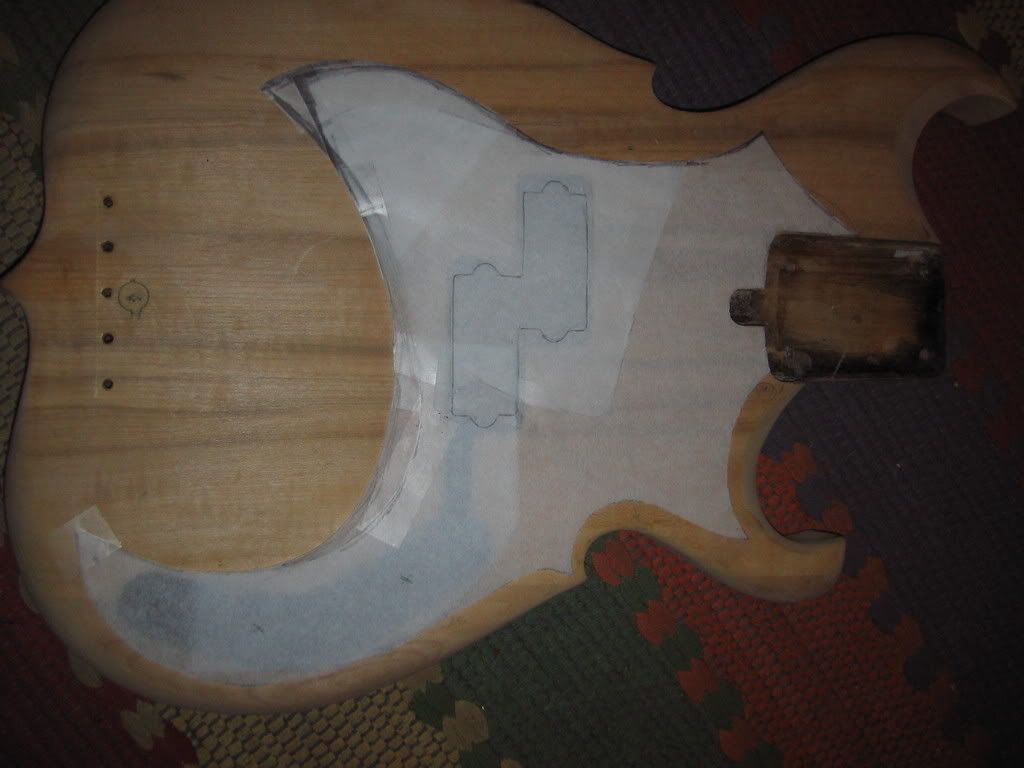
I started off with an early 70s poplar Fender Musicmaster Bass body that had been mercilessly routed for different pickups and then apparently broken in half and badly reglued together.  The body was a cheap ebay purchase - I think I paid $15 for it plus shipping.

The initial stages of rebuilding and refinishing the body are covered in this post.

I eventually tracked down a 1971 Musicmaster neck that had been defretted and a set of the fairly unique early Musicmaster Bass tuners.

Musicmaster & Mustang Colors

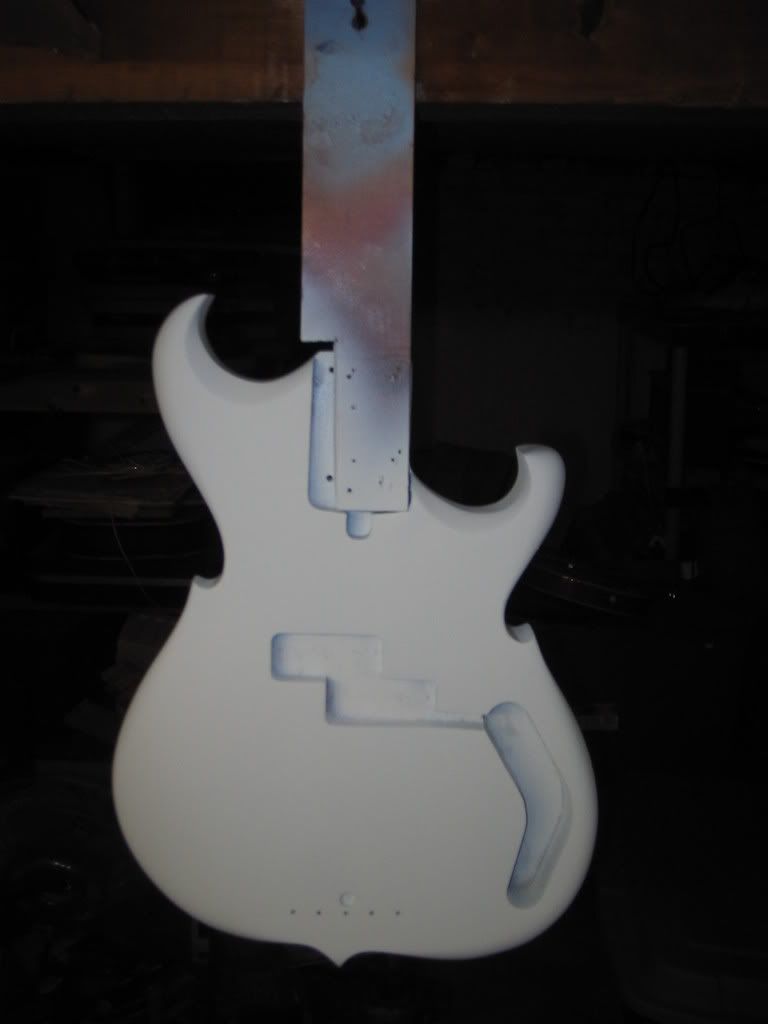
As is often the case - the large body plugs I had glued in when I repaired the body were showing their seam marks, so I ended up sanding the front and back faces of the body flat again and spraying a few more coats of Daphne Blue.

I decided NOT to do a clear coat over the color coat, in keeping with the style of original Musicmaster Bass finishes - though I will point out that Daphne Blue is not a "correct" color for Musicmaster (or Mustang) basses or guitars.

This family of instruments had their own formulations of blue and red - with the blue being a slightly darker and greyer variation on Daphne Blue and the red being a slightly darker version of Dakota Red.  I believe that at least from 1970 on, these were fairly thin polyurethane finishes as opposed to acrylic and nitro lacquer finishes - so it may be that the red and blue were "offset" colors formulated in a different base.  These colors also did not have clear coats applied over them, so they do age slightly differently than typical Fender finishes - with more darkening and less yellowing.

I'm not sure what was used to finish 1965 through 1970 Mustangs and Musicmasters - but my 1966 Mustang Bass does not appear to have a topcoat on it and the color is a bit different from Dakota Red.  If anybody has some details on this, please let me know or post a comment !


Putting It All Together


The neck was a straight-forward refret, using Fender's current "medium" guitar fretwire as opposed to the "jumbo" fretwire used on Fender's full-size basses from 1966 on.

I made the pickguard using an old hacked up Musicmaster Bass pickguard  as a pattern, though I later realized I could have bought one from WD Music Products pretty cheaply.  Those are Strat knobs on the controls in this picture - I replaced them with the proper Jazz Bass style knobs.


The bridge is a recent Bronco Bass bridge, as is the pickup - with rest of the parts (neckplate, knobs, strap-buttons) being standard reissue hardware.  The pickup is a bit different from the original pickup in that it has a bar magnet across the bottom of the pole-pieces (as is typical of many Fender Squier pickups) as opposed to just having magnetic polepieces.  I may swap out the pickup for a reissue vintage Strat or Mustang pickup eventually, as these are much closer to the Mustang/Musicmaster guitar pickups that were used in original Musicmaster basses (yes - there are 6 polepieces under the plastic cover for ALL those Musicmaster basses!).


The bass has round-wound strings on it, but those may also be switched to flatwounds - as I find that combination to sound particularly good on Musicmaster basses!

I do greatly prefer the slimmer 1976 and earlier Musicmaster Bass necks to the much chunkier 1977 to 1982 necks. The more recent Squier Musicmaster and Bronco necks are also of the later chunky shape unfortunately.

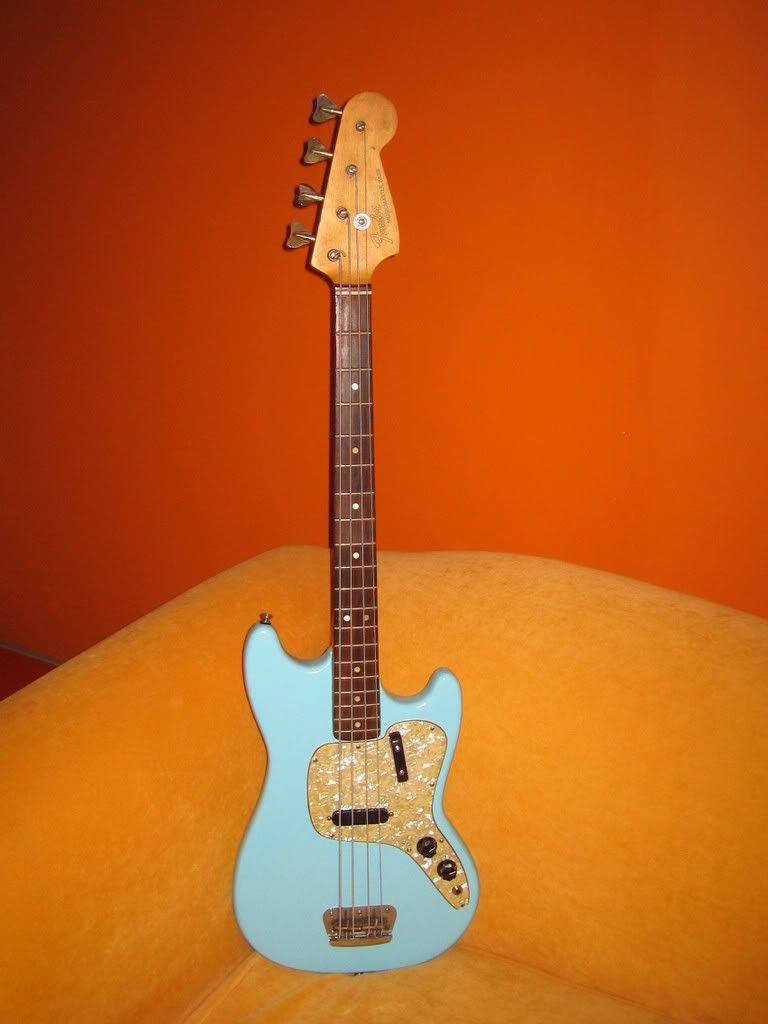
And here it is - complete !!


All in all - a good playing lightweight little bass !!
read more →

Musicmaster Disaster !! Another Daphne Blue Fender Bass

Here's an example of a rebuild project that honestly doesn't make a whole lot of sense in terms of "effort" vs. "value" - but what the hell. Its fulfilling to take an instrument someone has managed to destroy and bring it back to not only being functional but also looking good.

This project started off with an early 70s (71 to 73) Musicmaster Bass body that I got on Ebay. The body is made of poplar, as most of the early Musicmasters were, and had not only been very roughly routed out for a number of different pickups, but also apparently had been cracked in half at some point and then poorly reglued such that the body was no longer flat !! The good part was the body only cost $10 plus shipping .. because no one else bid on it.

So the first step was to REBREAK the body along the glue line - then reglue it while it was clamped flat. I clamped a maple board on each side of the break - parallel to the glue line - then put the body on the edge of my workbench - and hit the body with a mallet on the side that was overhanging such that the body split evenly.

Then I reglued the body - though there were some gaps from wood splintering - and clamped it flat. I used a liberal amount of Titebond to glue it all together.

I set the body aside then - until I randomly found a defretted early Musicmaster neck on the Denver Craigslist that was reasonably priced.


Finding the neck motivated me to restart the project. I then started the filling in process. As I said, there were gaps along the new glue seam, which I filled in with long splinters of poplar. At least the body was solid and flat now.

Next came filling in the routings - which as you can see were crudely done. I routed out the areas to slightly less than 3/4 inch, so that I could use regular 3/4 inch stock poplar to plug the body.

As you can see I routed out the body in 3 areas - one triangular area near the bridge, one rectangular area towards the neck and a large area below the stock pickup routing.


This picture has the three poplar block placed but not yet glued in position. Note that I cut the block so that the grain was in the same direction as the rest of the body - not sure that really matters on a rebuild of this magnitude!


I glued and clamped in the three poplar blocks plus some smaller pieces at the edges of the control routing and some small filler pieces here and there - the goal was to minimize how much filler I'd have to use.


Once everything was dried - I went around the gaps and used a two part plumbers epoxy as a filler for gaps. The plumbers putty doesn't shrink and has the consistency of plasticine or fimo. It is very dense but works great for filling in limited areas and is actually drillable.

Sanding everything down with a random orbital sander and a 100 grit pad brought all the filled in areas down to the level of the surface. Then a sanding with a 220 grit pad gave the front and back of the body a nice finish. Some block and hand sanding prepped the edges of the body for sealing.


I used the usual vinyl sealer on the body - spraying several heavy coats to seal the somewhat porous poplar body. I wet sanded with 320 grit paper between coats. Though the plugs are prominent, the body was really starting to shape up.


Because most if not all of the 70s Musicmasters didn't have a primer coat - I decided to move right to color coats after the sealer coats. I applied the Daphne Blue heavily, since it would be acting as a primer in effect. Once the first color coat was on, I sanded the body again, to reveal some high spots - in the process removing most of the blue finish on the front of the body - much as I would have with an initial white primer coat.


I then sprayed a few more coats, now that the body surfaces were really getting flat and smooth. The Daphne Blue really started to look good.


The next step was to look for all the little dings and spot flaws and apply Bondo glazing putty to fill these small imperfections.
Those red spots will be wet sanded and then a few more color coats will be applied - and a clear coat - and then I'll begin on the neck !


read more →

Radical Ibanez Roadstar BassMod, in Daphne Blue - Completed!

I finally finished this project - the humidity this summer really slowed things up - but I'm very happy with the final results.

As my original post showed - this bass started off as a run-of-the-mill 80s Ibanez bass. The owner reshaped the body and then had me finish it in Daphne Blue and cut a new custom pickguard for it. The original post is here.


read more →

Radical Ibanez Roadstar BassMod, in Daphne Blue


Here's a project I just started a few days ago - for a client from the local "Bassment" forum. This started out as an Ibanez Roadstar 2 Bass - presumably from the 80s. As you can see from a picture of the bass before any mods, it was a fairly conventional P-bass influenced instrument.


The owner wanted something with a more original and sculpted body shape, and carved the original body into a very different shape.


The novel body shape obviously required a novel pickguard - so after a few back and forths, we have settled on this shape, which I'll be cutting from 3-play W/B/W material during the coming week. The body has been sprayed with sealer - and after a final sanding, will be primed and then painted with a Daphne Blue color coat - watch for updates !!


(Update 6/29/08)
The project is moving on - after sanding the sealer coats the body was ready for a white primer coat. The primer coat revealed a few deep scratches and a few little dings, which were then filled with glazing putty.


The entire body was wet sanded and given one more coat of white primer- after which it looked like this!


Another quick wet sanding, and the body was ready for its first color coat of Daphne Blue nitro. The paint went on smoothly and there really aren't any flaws visible, so I anticipate finishing the color coats today and then applying a clear coat. As you can see, the bass is already looking pretty nice !

The plan is to apply a slightly ambered topcoat to the bass, which will make the Daphne Blue appear almost like Sea Foam Green (see the pics of the 1966 Mustang guitar I did as an example).

I'm also going to start work on the new pickguard - and after that this bass should be going together very quickly!!


(Update July 3rd, 2008)
The pickguard is cut and the body has a few clear coats on it. Obviously, the guard still needs to have holes drilled and a little bit of work around the pickup cut-out. The body will get another clear coat, then an "ambering" coat, followed by a final clear coat and a buffing out - next pics should be of the completed bass - sans pickup and control.

Happy 4th of July everybody - don't blow your fingers off or put an eye out !!!


read more →

Trio of Custom Color Fenders !! - Sonic Blue, Dakota Red and Daphne Blue

Updated this post to a three-some - a 1971 Fender Precision Bass refinished in Sonic Blue, a 1966 Fender Mustang guitar, refinished to its original Daphne Blue, with aging (see the post on that effort in my archive) - and an all-original 1966 Fender Mustang bass, in its factory Dakota Red finish.

Wish I had my Sea Foam Green 66 P-bass and Henry's Fiesta Red 64 P-bass to add to the picture !!!

The Mustang guitar is for sale .. see my post dedicated to this instrument.


read more →

SOLD!: 1966 Fender Mustang Guitar, Daphne Blue Refinish

Yet another project I recently took on - a stripped 1966 Mustang guitar. The guitar is mostly all there, with the exception of the finish on the body. The guitar was originally Daphne Blue and given what a nice color that is, and the Kurt Cobain connection, I have decided I will return this guitar to its original color.

As with many members of the Mustang/Musicmaster family of guitars and basses, the body appears to be made of poplar as opposed to the alder that Fender usually used. I say poplar because of the greenish color of the grain.


The changes to the guitar are limited to the following:
- two slider switches replaced with toggles
- one pot replaced with a 68 pot
- tremelo bar missing
- strap buttons replaced
- body stripped

The guitar is in very good condition and with a refin and a setup will be an excellent example of this classic 60s guitar. The case is worn but all there, and is covered in the proper silver-grey material with a burnt orange interior.

The main thing that has to be done is that the body must be sanded down and then refinished. Fortunately the body doesn't appear to have been too roughly stripped and the clear refinish appears to be lacquer of some sort, so sanding it smooth may actually provide a good sealer coat for the refin.


The first step is to disassemble the guitar. Note the traces of the original finish in the neck pocket and bridge cavities.


The pickups have hand written dates of "8-2-1966" on their bobbins to match the August 1966 neck stamp.


One last interesting feature are the two letters "ES" stamped into the wood under the pickguard - these may have been added later by one of the guitars many owners or may be from the factory - as the lettering is in the same style that Fender applied to factory refins during the 1960s - though I have no idea what "ES" would stand for.

I have ordered a gallon of Daphne Blue nitrocellulose from Eastern ChemLac for this guitar and expect to refinish it within the next week or so - check back for updates!


(Update, April 19th 2008)

The guitar body is now painted Daphne Blue - below are two pictures of the color coat, just after wet sanding and awaiting clear coating.


( Update April 22nd, 2008)

From Clay Herrel's alway's informative site (http://www.provide.net/~cfh) - here is an explantion of the "ES" stamp under the pickguard of this Mustang:

" In 1966, Fender used the "ES" code a lot on their custom color instruments. At least for 1966, the ES code was used as some sort of default for custom colored instruments (be it Teles, or Strats or Jazz Basses). This two letters ("ES" for "Enter Special") seems to denote a special order, at least for 1966. Again this is has been seen lots of times on 1966 documented original custom color instruments. I have also seen the "ES" stamp on some 1966 sunburst instruments! (Perhaps these guitars were special show models, so extra care was taken in their finish.) The 1/2" tall 2-letter code were a factory color code, and are completely different than the 1/2" tall three-digit codes. The two-letter code appears to be CBS/Fender's way of specifying bodies to be painted a custom color for a special order once the body was in the spray booth. If a guitar has a two letter code on the body *only* (and not the neck), again this confirms the 2-letter code was an original factory color code (and does not indicate a factory refinish order). But then there is this question: why do only some 1965-1968 custom color Fenders have this two letter code and others do not? It may have to do with how many custom colored guitars were being painted at any point in time, and the 2-letter code was applied to avoid confusion. Or it was applied just for particular special orders (like a Fender NAMM show guitar or a special dealer/artist order)."

So there you have it - someone wanted a Daphne Blue Mustang - and they wanted it NOW !!!


After clear coating - the body had a tinted clear coat applied , which slightly greens out and dulls the color - so that the finish looks more like an older Daphne Blue finish. This is with a little ambering - I will clear coat it again and then buff out the finish to a nice shine. This guitar should be ready this coming week!


With the parts just sitting in place - still need to replace those switches - but starting to look good !


(Update May 11 2008)

Ok another project completed and ready to go - this turned out to be a very cool little guitar. I was able to find a nice wiring diagram online and a few pictures of the wiring for an all original 'stang - which enabled me to replace the two switches and wire everything up correctly. I had to use some reissue cloth wire in a few places but was also able to save a bit of the 42 year old wiring.

I also replaced the one incorrect pot with a recent CTS pot, but the other pot, capacitor and jack are original.


The crazy dual switch set up of the Mustang guitar allows for some serious tonal variation - kind of cool, but I guess you'd really have to remember which combinations you want for which sounds. I found the one PHAT setting - very nice!


Finally - after wet sanding and buffing out the body - the guitar was ready for reassembly - and it turned out well - see below for a selection of pictures. I replaced the super light strings it had on it with a set of medium/heavy strings and loosened up the over-tightened truss rod - and the guitar dialed right in.

Just like good ol' Kurt Cobain used to play - except not a lefty !


I will be adding more pictures in the near future.


I am asking $1100 plus shipping for this guitar - though I am willing to negotiate downwards if you don't want the original 1966 neckplate.

SOLD - thank you to Axel in Germany - enjoy it !!
read more →

SOLD: 1971 Fender Musicmaster Bass, Daphne Blue


I just finished putting this gorgeous little bass together. I love the Fender Musicmaster Bass and actually use a red 1974 example with flatwounds live with my band. I purchased this one as a project about a year and a half ago, intending to use it with round-wounds for a more snarly sound.

This is a very early example of a Musicmaster Bass - probably one of the first handful produced, with a June 1971 neck date - and a VERY RARE pearl pickguard. By late 1971, all the Musicmaster Basses had switched to a 3-ply white guard. I have seen pictures of two other Musicmaster Basses with the pearlguards, and from the way its shaped, aged and the markings on the back, its obvious this is the original guard.


The neckplate is original, with the serial number being #311340, which is correct for 1971.


The body was in rough shape when I got it - poorly done spray can finish in medium blue, but after careful sanding, I got most of the multitude of refins off the wood and found traces of the original Daphne Blue finish in the neck pocket.


I refinished the body using Daphne Blue nitrocellulose, without any clearcoat, as the Musicmasters I have had skipped this step (they were entry-level instruments). The color will yellow and darken slightly over the years, but it won't turn green like on a 1960's Daphne Blue P-bass or Strat.


The body had some foolishness around the pickup route - its visible in the picture below. A little bit of a mystery since the original pickup was in the bass when I got it. Who knows?


The bass also had one non-original tuner - from a Rickenbacker 4001 apparently ? - I found a proper replacement tuner in my parts drawer, but had to dowel and redrill the hole for the A-string tuner, which unfortunately is visible since there are no tuner ferrules on this instrument. That being said, the neck is in excellent condition with the original frets and what appears to be the original nut.


The only replaced parts on the instrument are:
- tone and volume pots and the capacitor
- output jack
- one knob appears to be a replacement
- screws holding down the pickguard
- the screws holding on the neck are replacements as the originals were stripped and one was bent


Everything else - bridge, pickup, neckplate, guard, strap buttons, etc. - is original.


The bass sounds and feels great - sometimes I think these little basses are louder than my P-bass - but without of the sorta out-of-control loudness of a Mustang Bass. Total weight on this bass is roughly 7 1/2 lbs.

No case is included, though I believe I have a gig bag for it somewhere.

SOLD !! read more →